Helping parents see they’re doing enough.
Product strategy, concept validation and branding for Little Thinkers by Teamson Kids — a learning-and-development app that makes a child’s progress visible, designed to pair with a subscription toy box.
- Client
- Teamson
- Product
- Little Thinkers app and subscription box
- My role
- Head of Design
- Scope
- Research, product strategy, UX and UI, branding, user testing, roadmap
- Year
- 2025
The challenge
Teamson wanted to launch a direct-to-consumer toy subscription and a companion app — and needed to know which concept would earn parents’ trust and money first.
The insight
Even the most devoted parents live with a quiet doubt: am I doing enough? The product had to answer it by making progress visible.
The outcome
A validated concept, name and brand, and a phased roadmap starting with the app. 80% of the parents we tested with said they were likely to subscribe.
01
Context
Teamson came to us to launch “Project Wonder”: a direct-to-consumer toy subscription built around imaginative, role-based play. Partway in, the ask grew to include an app that helps parents join in play while tracking their child’s development.
So the real question became which concept was most valuable to bring to market, and how to position it. We built a process to answer it — business immersion, secondary research, experience optimization, user testing and product strategy — with research, strategy, design, technology and delivery working as one team.
02
What we learned
Category, competitor and developmental research gave us five truths about today’s parents, which we then checked with parents directly.
- 01Parenting is different for everyoneNo one-size-fits-all: values, culture and family shape every approach.
- 02It’s harder than it used to beTime scarcity, information overload and comparison weigh on parents.
- 03Parents are doing all they canThey invest in toys, classes and apps — and still wonder if it’s enough.
- 04Ease winsConvenience, guidance and low effort are now expectations, not perks.
- 05Parents want a partner in growthCompetitors serve narrow stages or skills; few support the whole child, and none had claimed imaginative play for ages 3–9.
Even the most devoted and intentional parents live with a quiet doubt: Am I doing enough?
03
Testing the value
We enhanced Teamson’s existing prototype into test stimulus, wrote three value-proposition territories and six candidate names, then ran a qualitative study with 20 parents who buy their family’s toys — 14 in the US and 6 in Canada.
Which promise resonates?
- Education65%
- Emotion25%
- Engagement10%
“An app that helps your child grow and learn through activities and helpful tools.”
Which features matter?
- Weekly play challenges65%
- Parenting & expert tips60%
- Development analysis60%
Features that showed growth and next steps rated highest.
Which name?
Little Thinkers
The standout pick — fun, smart and clearly about learning. Acorn Academy came second.
Also tested: Clyo, Bondy, The Wonder Room, Faebl, and Teamson’s existing brands.
04
Key decisions
Start with the app, not the box
The toy box brings sourcing, fulfilment and quarterly production. The app has far fewer operational dependencies.
The payoff: Immediate value for Teamson, and a home for the box to plug into later.
Lead with education
Position the app around learning and development — the promise 65% of parents chose.
The payoff: A clear reason to download, and to pay.
Make progress visible
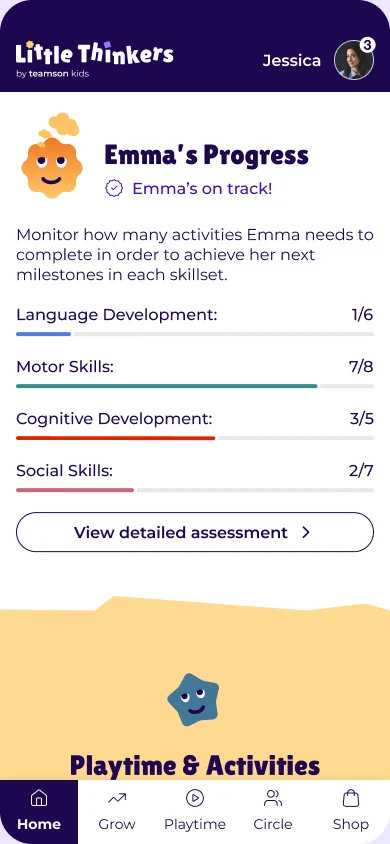
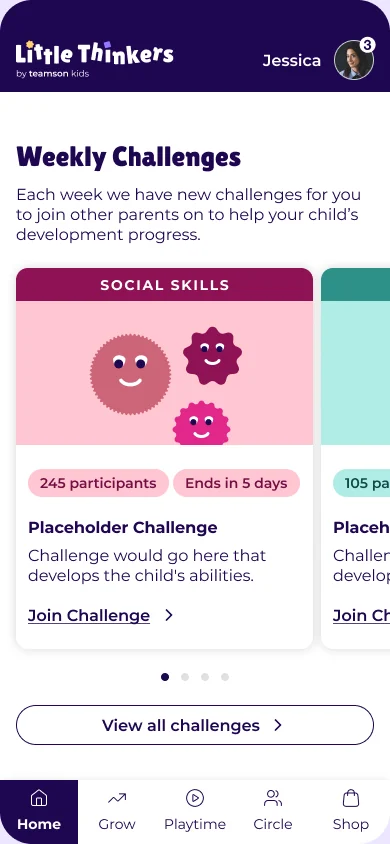
Progress by skill, upcoming milestones, weekly challenges and expert tips, all on the home screen.
The payoff: The direct answer to “am I doing enough?”
Crawl, walk, run
Phase 1 focuses on ages 3–5 with a lean feature set, built in two-week sprints over six months.
The payoff: Learn from real families before scaling to more ages and the subscription box.
05
The brand
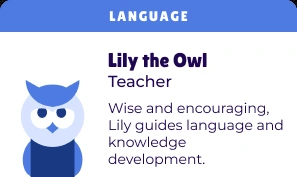
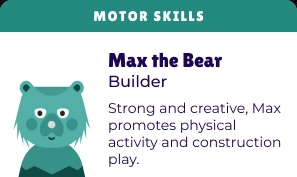
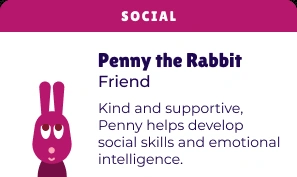
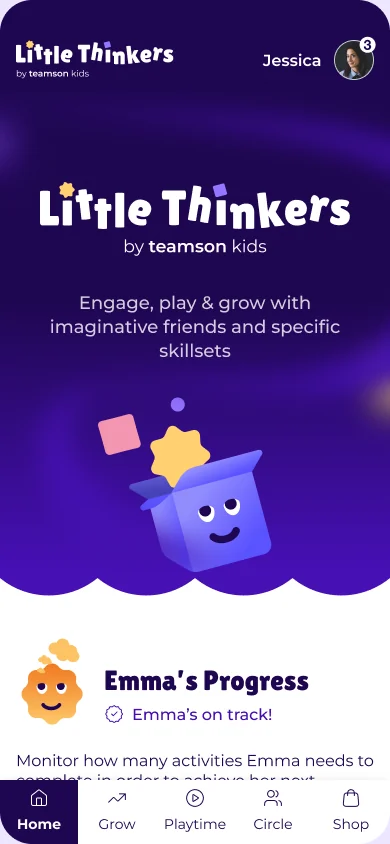
Little Thinkers sets bright, playful characters — the “Thinkers” — against deep purple gradients that feel magical and calm. The characters borrow the Teamson Kids palette; stardust, floating shapes and soft frames carry the sense of wonder from screen to screen.
- #1F0750
- #4710B6
- #9476FF
- #DBC9FF
- #FEC042
- #E0451C
- #52AFA8
- #CC6478
- #D9DAD5





06
The app
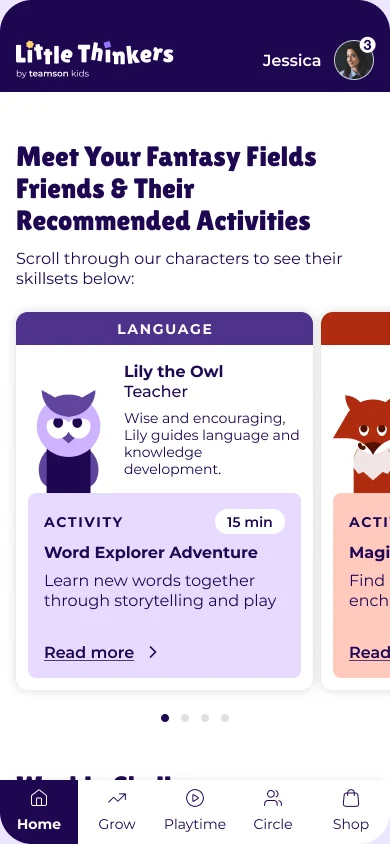
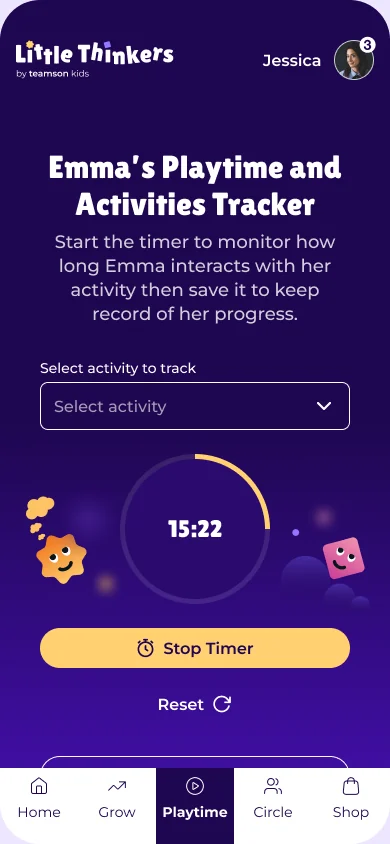
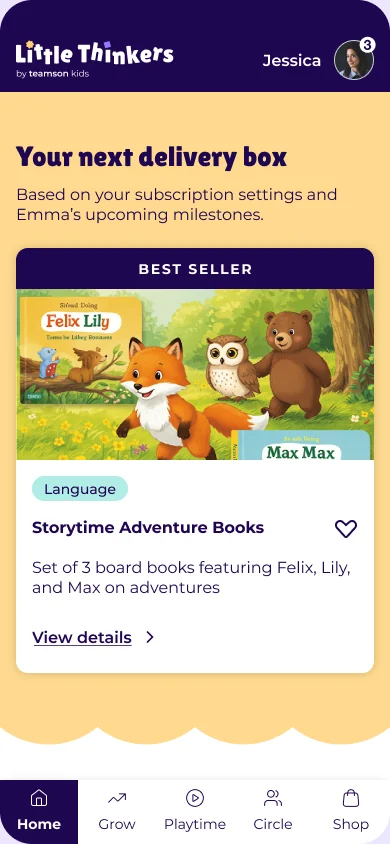
Every screen answers the same question for a busy parent: where is my child now, and what can we do next — in a few taps.
07
Crawl, walk, run
We ranked every feature by impact and effort, then sequenced them into three phases: ship a focused MVP, learn, then scale.
Crawl · Phase 1
A focused MVP, ages 3–5
- Weekly play challenges calendar
- Upcoming milestones
- Progress tracking charts
- Simplified parenting and expert tips
- Playtime timer and recent activities
Walk · Phase 2
Level up, ages 6–8
- AI development analysis
- Community feed and profile sharing
- Launch the quarterly subscription box
- Toy-box recommendations in the app
Run · Future
Scale with intelligence
- Deeper personalization
- “How to play” videos and digital events
- Digitally connected toys
- More ages and languages
08
Outcomes
80%
of parents said they were likely to subscribe to the app.
17 of 20
parents gave very positive first impressions.
65%
chose education as the app’s core promise.
$28
average monthly willingness to pay among US parents.
“It looks like it is quite transparent and easy to navigate. It provides a great deal of personalized information without feeling overly cluttered.”
09
Reflection
This was a classic case of testing an idea before building it. Teamson wanted to bring a new product to market, and our job was to sharpen how the product and the offer were positioned — and to prove the market was there — before any build, technology or go-to-market work began.
Doing that work up front meant every later decision, from which product to launch first to which features made the MVP, rested on evidence from real parents rather than assumption.